

Wizardly tomes, mysterious manuscripts and cursed volumes
The first place most people encounter rare books is not a library, but through their depictions in pop culture. Pop Bibliography is a theoretical framework to conceive the myriad of ways in which these “old books” appear across popular media, and what that can tell us about book history as a cultural concept. It is a visual manifestation of abstract ideas about the meaning, use, and reception of historic books, which deeply influences how both scholars and the public engage with these objects.
Allie Alvis, curator of special collections of the Winterthur Library in Delaware taught us about the many places Pop Bibliography pops up, and why it is so pervasive.
Wizardly tomes, mysterious manuscripts and cursed volumes
Susannah Helman: Good evening everyone. My name is Susannah Helman and I'm a senior advisor in the Curatorial and Collection Research Centre section here at the National Library. It's my pleasure to welcome you this evening. We are delighted you have chosen to join us for a journey into the world of rare books, curious manuscripts, and yes, maybe even cursed volumes. To begin, I want to acknowledge the traditional owners and custodians of this land, the Ngunnawal people. I acknowledge their ongoing connection to the land and pay my respects to their elders past and present, and through them to all First Nations peoples, here tonight all listening online. As a meeting place, Canberra has been the cradle of numerous stories, a country of creativity. The Ngunnawal and First Nations peoples across Australia have been keepers and sharers of stories and histories for millennia, and this is a legacy the Library continues to follow today.
Whether you're a book lover, a history nerd, curious about pop culture, or just hear for something quirky and fun, tonight's talk, exploring pop bibliography has you covered. We'll observe how old books show up in popular culture, in movies, stories, and games, and what that says about how we think about real rare books and manuscripts. We'll look beyond the bindings and consider why this fascination with magical and eerie texts exists in the first place. Tonight, we are joined by Allie Alvis, the curator of Special Collections at the Winterthur Library in Delaware. Allie's research is wide ranging, centred around how books are made, used and reused over time. They're especially interested in the physical signs of use in books, the history of ephemera, and beautiful arts and crafts book bindings. They've written about everything from rebinding illuminated manuscripts to quirky printing details in 16th and 17th century England to famous book binders like Douglas Cockrell & Son and the use of arsenic-based green pigments in book binding.
Allie is very active in sharing book history online. You might know them as Book Historia on social media, where they make rare books and book history accessible, fun, and very shareable. Achieving master's degrees in Material Culture and Book History and Information Management from the Universities of Edinburgh and Glasgow, with a background in linguistics from the University of Kansas, no doubt will all head home tonight armed with plenty of expert knowledge to impress our family and friends. Will you please join me in welcoming Allie Alvis?
Allie Alvis: Hello. It is wonderful to see all of you here this evening. I guess it is this evening at this point. I very much appreciate you coming out for this. I know it was a toasty day outside, and nice and cool in here. So let's get started. Very familiar book to some. A Volvelle spins around a depiction of a sturdy tower in a Western high mediaeval manuscript telling us the story of creation. The dial of the Volvelle continues to rotate, pointing towards an 18th century Persian manuscript vignette. And with the turn of a page, a miniature of the noble protagonist appears animated through impressive feats of paper engineering. Is this the hallucination of an overworked Special Collections librarian? Hardly. This is the record of a different kind of creation. It's the credit sequence to the 2023 film, 'Dungeons & Dragons: Honour Among Thieves'. This gleeful mishmash of book history is strategic.
It continues the pseudomedival look of the overall art design, and it takes advantage of the legitimacy granted to a story when it is related via an old book. But that's not all. By ending 'Dungeons & Dragons' with a sequence that brings together disparate but specific bibliographic formats and genres, the creators are making use of a specific aesthetic and symbolic concept. Pop bibliography. Pop Bibliography is a framework to conceive of the myriad ways in which old books are depicted across popular media and what that can tell us about book history as a cultural concept. After all, the first place most people encounter rare books and manuscripts is not the reading room, but through their depiction in pop culture.
But that's just the elevator pitch. In practise, Pop Bibliography can be somewhat difficult to fit neatly into a particular box. In some ways, it's book history. In others, it's reception studies. In still others, it's iconography. It's very much like the bibliographic objects that it centres on, which are a little real, a little made up, and a little something else altogether. Pop Bibliography draws both from the ideas of pop art and Megan L. Cook's concept of dirtbag medievalism, as well as popular culture more generally. In 1957, Richard Hamilton described pop art as popular, transient, expendable, low cost, mass produced, young, witty, sexy, gimmicky, glamorous, big business. By reframing and/or shoehorning traditionally low brow, everyday popular art forms and mass produced objects into the fine art category, pop artists invited introspection on why these things were valued so differently in the first place. In decontextualizing a lowly soup can or a single panel of a comic, artists created their own context for these pieces, referencing the original inform, but not necessarily in meaning.
Pop art's deep aesthetic grounding in advertising arts and popular culture also meant that it was able to take advantage of well-established visual language that was known to catch audience's attention. After all, it was being successfully used to sell things in its original context.
Similarly to Hamilton, Cook boils down her dirtbag medievalism, which addresses the earnest, bombastic kind of meta-medievalism distilled through the internet and pop culture, one might see at a mediaeval times restaurant or in a 'Dungeons & Dragons' campaign to 10 key features. It is commercial. It is a creature of mass media. It is accessible. It gestures towards historical accuracy, but is not too concerned about it. It is often more about the present telling on itself than the past. It does not aspire to cultural authority. It is ideologically porous. It is effectively earnest, but it is not primarily educational. And it can be a matter of intention or reception, but is more often the latter. Both pop art and dirtbag medievalism address the marketing utility of various media, as well as the idea that profit and visual appeal tend to be prioritised over concerns of accuracy.
The 20th and 21st centuries can be characterised by the ubiquity of vast varieties of creative media. Modern life is permeated by highly visual fiction, which people consume both actively and passively. In this hyper commodified media landscape, being a fan of a certain TV show or video game series is a powerful group marker with fandoms expanding from the early days of mailing material back and forth to online spaces, which are themselves heavily commodified. While fandoms frequently exhibit growth that resembles organic grassroots organising, they are not purely fields of wildflowers. This is agriculture with companies sowing the seeds for these fan communities in order to generate a profit. But this type of propagation is not done only through creating lovable characters and plot twists that keep us at the edges of our seats. It is done by crafting settings that resonate with particular groups, with a much broader remit than fan communities.
Jessica Pressman analyses this phenomenon as applied to books in her 2020 work, 'Bookishness', which examines the establishment of an identity derived from a physical nearness to books. She describes how books as a marketing and popular media concept offer intimacy as a refuge from digital capitalism and cultivate a fetishistic nostalgia for 'a time when books smelled.' This era of digital saturation finds individuals turning to microaesthetic trends such as dark academia or fandom communities that affirm their nostalgic or aspirational urges to demonstrate their bookishness. And some of the most potent ways of communicating a commitment to bookishness is through old books. But what makes the old book such a valuable tool for bookish signalling, particularly when wielded by media companies? For a general population that has more often than not, never physically interacted with a book printed or created before the 20th century, why does an old book on screen or a video game so succinctly communicate that the story is taking place in a mediaeval setting or that the person using it is a wizard?
Frequently, the old books in question present as what people in the field of rare books and manuscripts recognise as mimetic chimaeras of physical attributes from different periods, cultures and uses. However, certain repetitions of anachronistic forms emerge when looking at, say, magical tomes across various media properties. The creators of these chimaera books are clearly consciously and subconsciously referencing each other's work and aesthetic vocabulary. But where did this vocabulary originate and what can it tell us about the popular understanding of the book as an object? Furthermore, what does this mean for the present and future of book history? These are the questions that Pop Bibliography aims to address.
Umberto Eco's statement that we are still living under the banner of mediaeval technology is true of both the real world and the world of fiction, even if that banner acquires a few modifications in a fictional setting. The concept of the wizard's mystical gnarled grimoire very frequently uses the Western Middle Ages as its core aesthetic touchpoint. The early mediaeval rise of the Codex format has had a far reaching effect on the way Western culture conceptualises and exports ideas about both knowledge and the sacred, which is sometimes quite literally interpreted in media. Books being used as visual shorthand for knowledge is not a new concept. Strolling through any portrait gallery will yield a host of historic examples of upper class people explicitly using books and libraries as props to communicate the image of an intellectual. Books are more than repositories of text. 'They are icons of knowledge', notes Jessica Pressman.
In his influential understanding comics, cartoonist Scott McLeod lends an artistic perspective to the use of symbols and how they are crafted for efficient consumption. In his discussion of the appeal of cartoons, which he identifies as a complex form of icon, he describes amplification through simplification. This process of visual abstraction involves not so much eliminating details as focusing on specific details, thereby stripping down an image to its essential meaning, creating a distilled image that is more effective at communicating its message. McLeod further observes that the more cartoony of faces, for instance, the more people it could be said to describe. The same could be said of books, particularly in video game settings of the 1990s and early 2000s, where every visually rendered object carried a heavy cost on computing and display power. What was the advantage of adding details that make a book look old when they would have been easier to portray as simple rectangles?
These details are indicative of the importance art directors place on the meaning of books being old and all the facets that attribute speaks to.
In today's media, where such limitations are usually more of a stylistic choice than a necessity, it is often the book's meaning itself that becomes abstracted. Rather than simplifying the physical form of the old book, many creators instead lean towards a sort of hyper materiality where complex, heavily ornamented bindings do everything short of grabbing a viewer by the lapels and yelling, 'I'm old'. Meanwhile, the meaning of the old book becomes the cartoon, where the viewer is left to mentally fill in the blank with what old means to them. Whether the word carries an air of mystery, a sense of venerable intelligence, an inherent value, or really anything else. Each viewer will bring a different set of experiences to seeing or reading about a Pop Bibliographic book, which is an important function of the iconic relationship. Icons demand our participation to make them work.
Considering the general populace's unfamiliarity with old books though, media properties that feature such objects frequently overcompensate in their amplification of once functional book parts. These items have surpassed pastiche and achieved skeuomorph status with their hyper-material physical attributes serving little to no purpose other than to evoke pastness. Cornelius Holtorf describes the primary attribute of pastness as exhibiting a particular appearance corresponding to the past in your imagination. Exploring the concepts of created environments such as Disney theme parks, he notes that the level of attention Disney designers give to material clues and other details ensures that guests in the theme park do not admire the verisimilitude of what is ultimately complete artifice, but that they are made to put the very distinction between real and fake behind them. He quotes one of the designers of Main Street USA in Disneyland Paris. 'We're not trying to design what really existed in 1900.
We're trying to design what people think they remember about what existed. The concept of pastness is a principle attribute of Pop Bibliography. Books and manuscripts and fiction don't need to be accurate or even readable to get their point across. They just need to look like how you think you remember them looking. And when the only way most viewers have meaningfully interacted with mediaeval or early modern books is through fiction, creators are no longer making up objects that reference objects from the real world. They're referencing a reference to a reference. A classic case of Baudrillardian simulacra, substituting the signs of the real for real, a blurring of reality and representation. Both the audience and the creators of Pop Bibliographic objects view bookish icons not only through a lens of historic knowledge, but through the haze of historical-ish media cannon. The recursion is the point. An object is most credible when it corresponds to people's preconceptions and looks as they might imagine it might, thus confirming what they already know.
In this case, other fictional depictions of old books, icons of icons.
Pop Bibliography has its roots in older portrayals and receptions of books beyond the 18th century portraits mentioned earlier. Mediaeval panel paintings, sculptures, and illuminations embrace and perpetuate the book, particularly the holy book as a symbol, one that has suffused its textual aura throughout the work. And the majority of the people who might view these artworks had roughly as much experience with books as the general public today has with old books. That is, they may have seen a few, but they would have had no opportunity to physically interact with them. The books as seen in mediaeval art would have been more familiar and identifiable in the period in which they were created. However, with the shifting of time and shifting artistic styles, the books gained an air of the exotic through their decreasing aesthetic familiarity. Pop Bibliography traces its family tree back to the early Western Middle Ages, although it was significantly less pop in its early days.
Illuminations and paintings of the biblical annunciation that feature the Virgin Mary regarding a Codex as she is visited by the angel are this kind of proto-pop bibliography. At circa one BCE, when this scene takes place, the Codex says it is usually depicted in those scenes did not exist as a format of a book. These embellished books are sometimes recursive depictions of the manuscript in which the illumination appears within the illumination itself, but in many instances, the books are simply whole, well-formed, hefty objects that were designed to reflect the cultural expectations of their audience.
But what happens when, for the majority of experiencers of the text, there is no intimacy. For the people of the Middle Ages who were illiterate or not wealthy enough to own their own prayer book, what do these depictions of books signal? What kinds of feelings were they meant to instil? Similarly to Pop Bibliographic objects, the function of these illustrated books is not to be read like a traditional Codex, but to act as symbols that allow the viewer to access more complex experiences when consuming the media. Books in Western fine art continue the symbolic tradition even today, signalling not just religious cachet, but a whole host of meanings that mark the person or seen as bookish.
The pop in Pop Bibliography emerges with pop culture, fed by the rise in literacy rates and relative increase of disposable income in much of the West beginning in the late 18th century. The strange books that inhabit the draughty libraries of Gothic novels are probably the closest analogue to modern Popiliographic objects. The disfigured and mouldy volume that contains the spooky province all tale in Ann Radcliffe's 1791, 'Mysteries of Udolpho', the old, tattered and discoloured manuscript that relates the story of the immortal Melmoth in Charles Marturin's 1820, 'Melmoth the Wanderer', the perhaps anti-Catholic reference to the exceedingly rare and curious book in Quarto Gothic, the manual of a forgotten church that so fascinates Roderick Usher in Edgar Allan Poe's, 1839, 'The Fall of the House of Usher'.
With the exemption of the Poe example, these Gothic books are unnamed. They're meaning granted by the physical features that mark them as old or unusual. With the advent of the moving picture, Gothic books needed a physical body, and they often found it in that of a real historic book, sometimes with furniture glued on for good measure. These earlier media influences established a norm for the modern Pop Bibliographic book. We can begin to approach a more detailed understanding of the ubiquitous cultural impact of these curious and incredibly diverse cultural items by identifying some commonalities between them. They can be recognised by seven features. They are commercial. They are usually not the centre of attention. They are surreal. They are blends. They're fetishistic. They stray into the real world. They are not real, but don't mind being taken as such. These features are not meant as a checklist to definitively classify a fictional book as Pop Bibliographic or not.
To put it colloquially, Pop Bibliography is a framework that relies heavily on vibes.
Much of Pop Bibliography takes place on a subconscious level, both on the part of the creator and the consumer, with each party taking the form and function of the old book for granted. Affect is critical at this level and can be roughly correlated to vibes. Elaborating on the recognisable features of Pop Bibliography will bring those vibes into more focus. It is commercial. Similarly to Cook's dirtbag medievalism, Pop Bibliography's primary function is to make a prophet, chiefly, monetarily, but also in simple attention. Books and media look cool and interesting because someone wants them to look cool and interesting in order to engage a variety of audiences. Pop Bibliography does not make itself. This idea of what is appealing necessarily shifts with the changing tastes of audiences, which can be seen by tracking the visual development of books as featured in long-lived franchises such as 'Magic: the Gathering'.
Players now expect a certain level of complexity in Magic's card illustrations and by extension, the books that feature in them. The art directors are more than happy to oblige. The people making the upper level artistic decisions use a combination of Pop Bibliography and Pressman's bookishness to cultivate not just reader identities, but reader identities that prize the past. As Emily Lynell Edwards observes in her discussion of bookishness as portrayed via social media. For viewers who don't own their own books, there is simply nothing to show for the action of reading. Creating Pop Bibliographic items and settings provides these readers with content to show for their bookishness, further endearing them to the media property that best fulfils the identity they wish to embody.
It is usually not the centre of attention. Pop Bibliography can be seen in the background of films in which books are never addressed or discussed. It can be seen as the constant tool of the video game mage or as the key MacGuffin that will resolve a fantastic plot. It can even be observed in books humanised to various degrees who act as supporting characters. But Pop Bibliography is almost never the main character. The almost never caveat here acknowledges that within the fullness of human creativity, there are certainly some examples of fiction in which a Pop Bibliographic book is a protagonist with agency, but this is not true in a majority of cases. This relegation to the supporting cast or lower is by design.
Bookishness is particularly effective as an aesthetic when the audience has a humanoid avatar through which they can envision themselves in a fantastic environment and that they can identify with in the real world.
In their cartoon hyper-material forms, Pop Bibliographic books cultivate iconic participation, but do not offer the same avatar experience.
It is surreal. I mean this in almost exactly the same way that Andre Breton defines the term in his 1924, 'Manifesto of Surrealism', a super reality that resolves the previously contradictory conditions of dream and reality. For Breton and the surrealists, dreams were natural places where ideas could bloom unimpeded by logic, while being awake was simply a phenomenon of interference. Eco describes a variety of ways of dreaming of the middle ages, outlining ten little ones. His definition of dream in this formative piece aligns more closely with an interest or a striving for or a hope. The dream inherent to Pop Bibliography aligns with all of these, as well as embodying the wanderings of a mind asleep. It denotes an unconscious state where the meanderings of one's brain fade in and out of comprehension with what is real or accurate, becoming lost in the atmosphere, aesthetic and affect of a fictional space.
It also introduces a sense of unreliable narration, particularly when encountered by audiences who are not rare book specialists. If a historic setting otherwise seems accurate, wouldn't it stand to reason that the books in it are as well? Pop Bibliography is the image of what you think you remember about old books. As Breton concludes, 'Existence is elsewhere.
It is a blend. The diffusion and blurring of borders generates a sort of book stew for designers to dip into. This stew is full of chopped up, decontextualized physical attributes in different amounts. For example, a spoonful of the book stew will frequently contain a leather binding, conspicuous wear and tear, and manuscript contents, but sometimes you wind up with illumination from the Arabic tradition or a 19th century pictorial cloth binding'. The ending credits of the 2023, 'Dungeons & Dragons' film that we saw earlier is a spectacular example of this blending. The overarching art direction and framing it is a spectrum of Western late mediaeval illumination into 18th century Persian illumination. It hops from the manuscript to print, which appear a long 13th century bestiary inspired illustration. In other scenes of the credits, the aesthetic veers into the 19th century, incorporating aspects of chromolithographed moveable books.
It is fetishistic, not in a sexual sense, but in the older meaning of the word, an object of such reverence that it has an almost magical hold over people. Pop Bibliography exploits the remoteness of the general public from real old books to create desire, but this idea did not spring from the void. It is rooted in older cultural concepts. The historic unattainability of books contributes to persistent ideas of their mystique. The sense that certain kinds of books are perpetually out of reach is a remnant of the pre-19th century period, when the vast majority of books were outside the price range of the common person. The role that highly embellished books have traditionally played in religious contexts also lends them a sense of sacred untouchability, as do the handling practises of Special Collections reading rooms, the myth of white glove use when working with rare material is an excellent example of this.
Though many people understand that old books should be handled differently in some way, they're often not aware of the specifics and sees on what they've seen in pop culture. This mentality of the old book as literally and figuratively out of reach is perpetuated in the 21st century by misconceptions about the accessibility of Special Collections libraries and the high price of certain rare books and manuscripts on the market. At the same time, books as a commodity are so ubiquitous today that their form and function are generally taken for granted. But the mediaeval manuscripts, early modern herbals and massive religious works sporting bars and chains that inspire the depiction of books and fictional properties are no less real than the books on your average shelf. However, with the introduction of a veil of Pop Bibliography, non-specialists can have their bookish reality shaken, which can be compounded by the insensitivity of professionals.
In 2023, Marsh's Library in Ireland posted an anecdote on social media. 'Are these books real? This question is coming up more and more often on tours'. It's as if some people are so used to living online that they can't quite understand reality. In this case, the remoteness that contributes to the fetishism was amplified rather than reduced by experiencing real old books in person.
Pop Bibliography strays into the real world. Circling back to its commercial nature and contributing to the fetishism. Pop Bibliography is a prime candidate for merchandising. Shops in Disney World sell embellished blank books that are replicas of the pseudo-medieval storybooks that feature in the opening sequences of Disney's 'Sleeping Beauty' and 'Cinderella'. Book binders ply their trade in the halls of fan conventions, selling detailed replicas of the 'Book of the Dead' from 'The Mummy', or Bastian's book from 'The Neverending Story'. This aspect of Pop Bibliography dovetails with the audience's desire to see themselves not as the fictional books, but as the people wielding the books. Owning a replica of a Pop Bibliographic book in the real world allows them to more closely embody the bookish image they wish to cultivate. However, items such as paper blanks journals, which are notebook reproductions of extent rare books and manuscripts are not Pop Bibliography.
They're classic examples of Pressman's bookishness in which someone seeks to portray their readerly identity by referencing literary classics or historic works. Choosing a 'Sleeping Beauty' replica blank book over a book of 'Kells' replica blank book says very different things about an individual. I own both, by the way.
It is not real, but it doesn't mind if it's taken as such. Facsimiles and referenced reproductions can only be Pop Bibliography in specific contexts, which is why I'm excluding paper blanks. In order for a book to fit the Pop Bibliography mould, someone has to have gotten kind of weird with it. While most people don't look at a wizardly tone in Dr Strange's library and assume that this is an actual historical object in the real world, they very easily could get that sense from Jennifer Lopez receiving a first edition of 'The Iliad' from the male love interest' in the 2015 film 'Boy Next Door.' Even though this prop book is a real 1884 Chicago edition of 'The Iliad', it has become an object of Pop Bibliography through its context. Real is deeply subjective when it comes to Pop Bibliography.
We can see how Pop Bibliography manifests in media through using the trading card game 'Magic: The Gathering', published by Wizards of the Coast as a case study. I am not going to explain the rules of 'Magic: The Gathering' to you in this talk. I know most of you would just walk out and some of you already know, I can tell. 'Magic' has a sometimes subtle, sometimes explicit relationship with books and their physical forms. From the design of the backs of the cards to resemble book covers to the in- game terminology for a deck, a player's library. Books with physical aspects that mark them as old serve as visual shorthand to create a particular environment and atmosphere when they appear in card art and also contribute to the construction of a sort of manufactured cultural nostalgia that is meant to immerse a player. Wizards of the coast parent company, Hasbro, notes a 50 million strong player base for magic.
Over 27,000 unique illustrated cards and an ever-expanding collection of lore that adds dimension to the gameplay. With limited space on each card for storytelling, the efficiency of communication is everything. Card art does this narrative heavy lifting, adding context and flavour to game mechanics and creating a space for players to see themselves. The many worlds of magic are situated in the broad category of fantasy, which owes huge aesthetic debts to the Western mediaeval period. The game's artists and designers use a number of visual cues to establish this setting and feel, including the presence or absence of books.
In magic, players take on the role of planeswalkers, magical beings that can usually navigate between different realities called planes in the context of the game, who are engaging in wizardly duels with each other by casting spells and summoning creatures as represented by the magic cards. The cards also contain units of the magical energy needed to power their wizardry in the form of five colours of mana, represented by a card type called land. All magic cards display the same layout in their base form, card name at the top, followed by an image, then the cards type, and finally the card's text, which describes how the card is used and its effects. Sometimes there will also be italicised flavour text, providing storyline context or anecdotes that are not strictly necessary for gameplay. Each player begins the game with a set life total based on play format.
To win, a player must get their opponent's life total to zero by attacking them with creatures and spells. Within magic, the setting lore and plot are generally called flavour by the game's designers, hence flavour text. The flavour text is the only in- game explanation for how the events, objects, and figures depicted in the card art interact with each other in the overarching narrative of each new set of magic cards, which are released quarterly. Mark Rosewater, Magic's Chief Designer, freely admits that the trading card game format is not the easiest place to tell a story, and this mindset has allowed wizards of the coast to focus more on cultivating a game environment rather than a full narrative.
Books are one tool used to create this game environment in both a meta and literal sense. As previously mentioned, in magic terminology, a player's deck of cards is called a library. Rosewater elaborates on and somewhat muddies this metaphor by noting that the entirety of the power at a player's disposal is contained in a library of magic spells, obviously kept inside some magical book. Another method of winning the game is by making your opponent draw all of their cards, thus depleting their library and preventing them from taking any more magical knowledge from it. This concept is reinforced by the design of the backs of all magic cards, regardless of the set or front design, which Rosewater notes was designed to look like a magic tone. The design appears to have been inspired by an 18th century modelled calf binding with a central panel with the addition of bosses or gemstones.
The bibliographic motif was further driven home in the packaging design for the early starter decks, whose boxes were adorned with page edges and even a protruding bookmark. So even before getting to the cards themselves, we're seeing Pop Bibliographic calling cards. It's not the centre of attention. You're not playing as a book, but using the book as a tool, a blend. Why are there gemstones on an 18th century modelled calf binding and straying into the real world? Players demonstrating their bookishness by playing the game that comes in a box that looks like a book, and it only gets more Pop Bibliographic from there. Many books that appear in magic card art feature physical attributes that read as mediaeval or otherwise of the past. Chained books are a common site with the chains used not only in the traditional sense of being an anti-theft device, but also in quite whimsical ways to keep buoyant books from floating away or to create a menacing atmosphere.
Metal furniture is another binding attribute that is common throughout the planes of magic, taking various familiar and less familiar forms. A particularly flexible motif is the central roundel on the front board. While it is sometimes a metal boss, the roundel most often takes the form of a cabochon gemstone, similar to those found on Western mediaeval treasure bindings. The contents of the book are less often showcased in card art, but also reveal strong Western mediaeval and early modern manuscript inspiration. Their pages are usually yellow hued either to imply aged paper or that they're parchment. There is almost always a focus on the book's illustrations and general page composition rather than an effort to convey textual information. This is primarily for logistical reasons. The small size of the art as it's printed on the cards makes it difficult for the text to be reproduced clearly. And magic's massive international distribution means that the text incorporated into the art would be challenging to adapt for localization.
This affordance neatly encapsulates an important aspect of the Pop Bibliographical object. It banks on the idea of a book as something to be read, but is an object which by its very nature cannot be read. From Magic's inception, game designers and artists use the fetish status of old books to enhance the setting and draw players in. Jesper Myrfors, who is Magic's original art director and the designer of the book cover that appears on the back of every card, described how his aesthetic choices were informed by the fact that fiction and even history are filled with magical books. And Richard Garfield, who created the game, noted that he specifically wanted a player's deck to be called a library to impose a layer of ambiance on the very act of drawing cards from it. In order to get a sense of how this ambiance is fostered, it is useful to bring in the perspective of the artist responsible for the card art.
Some, such as Randy Gallegos, artist of 'Tome of the Guildpact' seen here, described that they looked closely at individual physical books to get a sense of certain aspects of their form. In this case, the damage to the spine revealing the book's structure. But others, including Howard Lyon, who illustrated 'Enlightened Tudor' and Dan Scott, who illustrated 'Cogwork Librarian' have said that they didn't think about the books too much, or noted 'old leather bound books' as a broad category of inspiration. Still others, such as Kieran Yanner, artist of Vessel of Malignity, expressed that he or [unclear] like was inspired by extant fantasy books, such as the Necronomicon from the 'Evil Dead' or books as illustrated in 'Dungeons & Dragons' manuals.
Interviews with these and other artists who work for Wizards of the Coast on 'Magic' revealed key details about their references to actual extent old books. A pattern that emerged is that artists often couldn't pinpoint their inspiration for certain physical attributes of the old books that they painted. The designs arose from a nebulous general concept of how old books should look, which was primarily drawn from other media representations rather than firsthand encounters with the books themselves. Generally, the artists tended to use Google images as a starting point, which is not surprising. Different library catalogues and digital repositories can be difficult to navigate even for seasoned rare book professionals. Common search keywords for the artists included ancient tome, which turns up a fascinating variety of material. This is the kind of self-perpetuation inherent to Pop Bibliography.
Folio of Fancies from the 2019 'Throne of El Drain' magic set is a prime example of Pop Bibliography in action. In my interview with the artist, Colin Boyer, he noted that one of the only strict requirements the art directors had for him was the inclusion of this keyhole motif. The keyhole is repeated on the robes of The wizard, Gadwick on another card from the same set called Gadwick, the Wizened. Folio of Fancies and Gadwick the Wizend are partner cards, both in their in- game functionality and in their aesthetics. In the Gadwick, the Wizened art, we see that Gadwick is pondering the book featured in Folio of Fancies front and centre, while its winged friends flit around in the background. The keyhole motif shared by these cards is a clue that Gadwick and Folio play well together mechanically.
Boyer cited two broadly defined pieces as aesthetic sources for the page decorations of Folio, an unspecified illuminated manuscript and a manuscript by Leonardo da Vinci. The illuminated serpent that appears on the left page is clearly inspired by a mediaeval bestiary, likely the 12th century Aberdeen Bestiary, given its fame and the fact that it has been fully digitised, leading to a profusion of its miniatures across the internet. Meanwhile, after a great deal of flailing around in Getty Images, I was able to source the da Vinci illustration to his 'Paris Manuscript C' which was executed in the late 1480s. Boyer's art represents two works that are nearly 400 years apart in history, quite distant geographically, and from two different fields of study as part of one book, presumably as executed by Gadwick or some other individual in fiction.
Many magic cards depict the vibe of what old books should look like as a delightful mishmash of mediaeval and early modern characteristics passed through the lens of extent fantasy aesthetic vocabulary. It gives us a fascinating glimpse of how the artists and designers of magic conceptualise and leverage the idea of old books. Referencing historic forms helps to construct a mythos for the players to inhabit and has thus translated to commercial success. Mark Rosewater noted that for a significant period, the Strixhaven set, which specifically foregrounds bookishness and Pop Bibliography through its setting at a magical university, was the bestselling premiere magic set of all time, replaced only by the Lord of the Ring's tie-in magic set. The people at the helm of magic cultivate a sense of nostalgia and identity specifically through the inclusion of books and their environments to evoke a sense of the fictional past.
At the same time, they reinforce the idea that books are a thing of the past by putting them in a wider neomedial context and rarely featuring them when the franchise dabbles in science fiction.
Establishing the idea of Pop Bibliography is not an effort to scold non-specialists for depicting books incorrectly. It is not a prescriptive concept. Rather, it is descriptive. Acknowledging the presence of Pop Bibliography content allows us to get a sense of how people outside the field conceptualise the past and of how they understand book history in general. As Simone Murray notes in her discussion of the dark academia aesthetic, creative takes on phenomenon like Pop Bibliography are how ideas about the literary world and book culture more generally are mass cultivated and publicly circulate in the digitally saturated age. Encountering the chimaera books of Pop Bibliography is sometimes the first inkling that a person may have about becoming a rare book professional.
Furthermore, Pop Bibliography is a framework which shines a bright light on the saturation of Western thought and colonialism in media, particularly when this saturation is subverted. For example, some Japanese anime and manga re-envision recognisable Western histories and tropes, infusing and inscribing both traditional Japanese and larger contemporary capitalist ideologies into their stories. Like Western neomedievalism and Pop Bibliography, 21st century Japanese depictions of the mediaeval now primarily draw on earlier popular depictions of the era, such as the 1980s anime 'Record of Lodoss War', which was itself based specifically on how the Western mediaeval is portrayed in 'Dungeons & Dragons'. An interesting phenomenon in neomedieval anime is the mix of modern pop culture with the mediaeval landscape. Part of a reason for this mixture is that the representations of the Western mediaeval are only ever just that. Representations. The Western mediaeval does not play a role in Japanese cultural history or memory.
Japan's exposure to the Western mediaeval has always been mediated through movies, books, cartoons and other media. For the Japanese, the European mediaeval is an exotic place for which the primary frame of reference is this imported media. The genre and its contents are hyper-fetishized and in some ways more prepared to get weird with the ideas of reality, thanks to a lack of cultural nostalgia for the period. While Pop Bibliographic objects that resemble Western books are fetish objects in both Western and in Japanese media, they're fetishized in different ways. In the West, they are often comfort objects, symbolic of an apparently nobler, more beautiful time. But in Japan, they mark the environment as other through their very presence.
There are many more facets of Pop Bibliography to be explored, and I hope that laying out this framework gets people thinking about why those weird old books and their favourite media look the way that they do. I also hope it encourages people to be more confident in visiting and learning more about rare books and manuscripts in their local Special Collections libraries. After all, they're the ancestors of the Pop Bibliographic books that they may be familiar with. Finally, and as part of that point, I hope more commercial artists and prop designers dig deeper into special collections. Pop Bibliography is already pretty weird, but I have full confidence that our creative colleagues can make it even weirder and more fun for people like me to study. Thank you.
Susannah Helman: Hello. We have some time for questions here.
Allie Alvis: Yes.
Susannah Helman: Thank you so much, Allie. We have some time for questions. If anyone wants to raise their hand and wait for the mic.
Allie Alvis: Should have had an audience plant.
Audience member 1: What's your favourite example of Pop Bibliography?
Allie Alvis: Ooh, that's a hard one. I do love ... There is a ... Let me see if I can pull it up here. There is a mascot creature from 'Magic: The Gathering' called Codie, Vociferous Codex. He is the guy on the little tripod bookstand there. As part of his character, he is like the guide to this magical university Strixhaven. He speaks in a Bronx accent and is generally kind of a jerk. And I just love that for him. And the sort of composition of the face and how that is made with book furniture and how he's ambulatory. I just really like him as a Pop Bibliographic thing.
Audience member 2: Follow up. Do you have a Codie Commander deck?
Allie Alvis: Follow up question. Do I have a Codie Commander deck? No, because I'm terrible at Commander. I play very, very basic magic.
Audience member 3: You said you wanted to see creatives do weird things with Pop Bibliography. What is the weirdest thing you have seen in a rare book?
Allie Alvis: Oh, what is the weirdest thing I've seen in a rare book? That's a really good one. I've seen at the University of Edinburgh, this probably isn't the weirdest thing and I'll think of it later, but there is an early printed book there with chicken footprints in it. They're little dirty footprints of a bird that apparently walked across this manuscript and they're still there for posterity. I really like evidence in books that sort of dirt and use and marginalia that really speaks to, well, either the human presence in the book or some other presence in the book. I just like that context of imagining someone reading this relatively large early modern book in the same space as a chicken was marching around. I don't know. I just find that fun. Oh, question in the middle. Oh, back there first, I guess. We'll get you next.
Audience member 4: Hello. Instantly regret raising my hand. I just want to ask your opinion of, recently there's been a bit of an upturn in the commercialisation in the literature field. So for example, if you love a series, you don't just own the paperback, you own the hardback, you don't just earn the hard back, you own the sprayed edges, you don't just earn the sprayed edges, it's signed, and then UK versus US and da da da da da. Because I would almost say it's a bit of a fetishization of the physical object. Do you think that overall, even with the rise of subscription boxes like FairyLoot and [unclear] and et cetera, et cetera, do you think that this is overall a positive thing or a negative thing given the oversaturation in the market?
Allie Alvis: That is a great question and good poll with the FairyLoot. If you haven't read it before, Rebecca Romney wrote a really good article on the sort of FairyLoot and the 'made collectible', which is this sort of creation of an object that is made to be rare for the specific purpose of being collectible, whether it has special edges or a special binding or special art or whatever, only X number are produced and it drives this demand. In some ways, I think this is positive because I like pretty things and I like to look at them, but in many other ways, this is very indicative of our sort of materialist, fast insert product here, society where you can have the e-book, you can read the e-book, you can have all of these different collector editions. I do think it's great because money is going to the authors of these things generally.
That is to say, if people aren't buying these books and then reselling them, I know that there are legal rules against that sort of thing. But I mean, it just depends on, I guess, how you're using this material. If you are simply buying the books to display them for your TikTok video, you do you, that's not my business, whatever. But I want people to engage with this stuff because they are reading it and engaging with the material rather than just looking at it as pretty stuff. But I do know that looking at it as pretty stuff is the gateway drug to the Special Collections reading room. So you just kind of hope that the seeds get sewn.
Audience member 5: So I was really interested in your notion that Pop Bibliography doesn't actually have to be real. It just has to sort of give that affectation. In your experience, where have you found creators who are trying to actually make it look as real as possible? So people, you're not quite sure whether it's real in the work or not. Do you have some examples of that?
Allie Alvis: Yeah. So there's a great video game that came out in 2023, I believe. It's called 'Pentiment'. It's a very simplistic structurally game where you play as a character named Andreas Maler, who is an artist. He's travelling around in Germany, learning art and stuff. He encounters grizzly murders and has to solve them. It's a little bit of a detective thing, but it's done in this style that severely evokes both early modern printing and mediaeval manuscripts. And it is so beautiful because the artists and art directors directly reference that stuff. The game has a bibliography for God's sake, and it was very, very popular. This is an example of, it's not necessarily what one would call a AAA game, but it was made by a studio which has produced AAA games. It's called Obsidian, and they produced the 'Fallout: New Vegas' video game, which incredibly popular.
So they are known for doing this kind of big ticket item and sort of tying themselves to this bookish, extremely well researched, extremely leaning into that aesthetic work. It's a great example of this. There are other video games out there that do that sort of thing that aren't necessarily as popular or made by as big studios. And there are interesting films out there as well that really enjoy the process of creating this material. There is a series, I believe it's on Netflix called 'The Lost Flowers of Alice Hart'. I actually, when I was teaching Pop Bibliography at the State Library of New South Wales last week, had the art director of that series come and talk to my class about the prop book that she created for 'The Lost Flowers'. And she did go to special collections libraries and called up stuff and sat in the reading room and studied it.
And some of it is like directly reused from these real historic books, but in a different context or interpreted in such a way that it fits the series. So I think that that's another good example.
Staff member: Allie, I've got a question for someone watching online. Oh yeah. Ok. Our viewer says, It seems, based on what I've seen in media representations, that Pop Bibliography is used to refer to pasteness in general, but also often to magic fantasy specifically. Is there a reason for that?
Allie Alvis: I think because it's easier to get weird with fantasy. You're not constrained to the realities of this is the history of Catherine the Great, and we know what kinds of stuff that she owned and we know what her whole deal was, so we can't go too outside the bounds of what we expect there. But if we're thinking about Gadwick, the Wizened, the wizard who has this keyhole motif and cultivates books with wings, then you have a lot more freedom. And I think that that is the sort of desire of the artists creating this stuff shining through, not necessarily in the face of the capitalistic inclinations of the companies and franchises that they have to work for. But it's just that exhibition of human creativity that they don't just make a standard sort of blah object. They get interesting with it. They add their own touches.
They think, 'Ooh, what would be strange about this book? Why would they give Codie the Codex a Bronx accent? What on earth?' So I think that there's something to that in terms of why fantasy. And then you have something like 'Game of Thrones', which is fantasy. That is straight up fantasy. There's dragons in it. For those of you who don't know spoilers, but a lot of the audience kind of took it as this gospel portrayal of what the Western Middle Ages was like. And so a lot of the discourse online was like, 'The gender roles are wrong. Women would never do this.' And it's like there's dragons. I'm sorry, did you miss the dragons? So yeah, it's important to sort of balance the fantasy and the real. Morgan.
Audience member 6: Hi Allie. I was at Allie's course last week and I think talking to the art producer for 'The Lost Flowers of Alice Hart' was just phenomenal. I have a question for you. How did you start to see these things? How did you start to see Pop Bibliography around you? What was the catalyst, if there is one?
Allie Alvis: Yeah. I mean, growing up a child of the 80s and early 90s, I watched 'Dark Crystal', I watched 'Labyrinth', I watched 'The Last Unicorn'. Those sort of aesthetics really underpinned the establishment of my personhood. And it was always something that played in the back of my mind of like, 'Yeah, I like this kind of medievalish weird stuff.' And actually, it was when I started dating my partner, now husband, who is present in the audience. He's with us here tonight, folks, round of applause. He started teaching me how to play 'Magic: The Gathering' after years of avoiding being taught how to play 'Magic: The Gathering'. And as he was teaching me and I was not understanding how to play 'Magic: The Gathering, I kept seeing these pretty pictures on the cards and eventually I did learn. But because there's so much art in 'Magic' and there's so many different settings, you start to pick up patterns across it where like, yeah, there's a bunch of wizards in magic.
Everybody's doing magic. There are lots of dragons. There are lots of sort of roboty type things, but that are animated by fantasy magic. And everybody seems to be throwing these old books around. And as a Special Collections librarian, I was like, 'Wow, there's a lot of old books in this'. And it was actually Codie, Vociferous Codex, who kind of was the straw that broke the camel's back of like, I need to study this. There is something weird going on here. And once I started sort of diving into it, I realised how deep it went, that it really does tie back to classical depictions of the written word, that it's not just something that sprung out of the Marvel cinematic universe and Dr Strange having weird books.This is something that's really baked into our visual aesthetic and narrative as human beings. And it is being portrayed in such a way now that it is extremely ubiquitous and in a more exciting way than I think it has ever been.
I know the person in the lime green has had their hand up for quite a bit.
Audience member 7: Have you come across a curse book or a book with a sort of past that you've really enjoyed?
Allie Alvis: So the question is, have I come across a cursed book or a book with a sorted past that I really enjoyed? So first of all, curses are real, at least book curses. So people did actually write curses into their books to sort of discourage people from stealing them like, 'Steal not this book, my honest friend or else the gallows may be your end for here you see my name written, book owner name'. There is a great school book that I actually bought for myself, which has a school girl's book curse in it that is like, 'Still not this book for fear of your life, for here you see this butcher's knife'. And there's actually a knife drawn in the book and it's like, whoa, they're serious about this. Funnily enough, you often see book curses, particularly in school books. And you would think like these kids, I don't think that they would mind if someone stole their schoolbook.
I don't think that that would be heartbreaking for them, but it's also just sort of a fun thing to do and something to show your friends and getting creative with these book curses. I haven't found a book that is truly really super duper cursed. I've not been haunted by anything yet, knock on wood, but I'll let you know if I find something like with a vampire in it or something.
One more question, and I think they already have the mic.
Audience member 8: Thank you. Given that all of this is based on like shorthand telling us things that we already know, do you have examples of Pop Bibliography that maybe like purposefully challenge or subvert these expectations and what that might look like instead?
Allie Alvis: That is also a very good question. I think in order to subvert the expectations, oftentimes you have to really engage with the real objects, but also sort of expect a certain level of knowledge from your audience, which often times isn't there. I do think that first edition of 'The Iliad' is fascinating because I mean, I think everybody knows 'The Iliad' is real old, like older than the 19th century old. You don't have to know that it is an ancient poem and yada, yada, yada, to know that it is not from the 19th century, but sort of having that, framing it as this first edition, having the Jennifer Lopez character react as though this is like the coolest thing to ever happen in the history of mankind. It's just the expectations of the audience must be really low for them to think like, 'Yeah, we'll take that'.
That is not a scroll of parchment with Greek written on it, but close enough.
I think actually one of the Dr Strange examples is good. You see this book that he's taking down off the wall. The books are stored in a sort of wall in the first Dr Strange movie. It's crazy. But you often see chained books in fantasy and fiction because chains are kind of creepy and kind of goth and whatever, but the changed books in the Dr Strange library are actually like chained so that way you have to remove the chain to take them from the shelf. I don't know. I find that an interesting use of that sort of common physical aspect of a Pop Bibliographic object to actually give it a function that the character has to interact with. It's not just that the book has a chain on it, the character has to unchain it from something, in order to read it. And I think that was the last question, but I'll stick around if you have any other questions.
Thank you to all of you for coming out tonight. Thank you to those of you online who tuned in. And I'm not sure if there are anything else else to say.
Susannah Helman: Thank you so much, Allie. I was just going to thank you for that wonderfully entertaining presentation and for taking us on such an amazing journey through wizardly tomes, mysterious manuscripts and cursed volumes. I think we'll all be looking at old books a little differently now. Thank you to our audience for those thoughtful questions, both here and online. Please join me in thanking Allie once more, and thank you all again for coming tonight, either in person or online. We look forward to seeing you again soon.
About the speaker
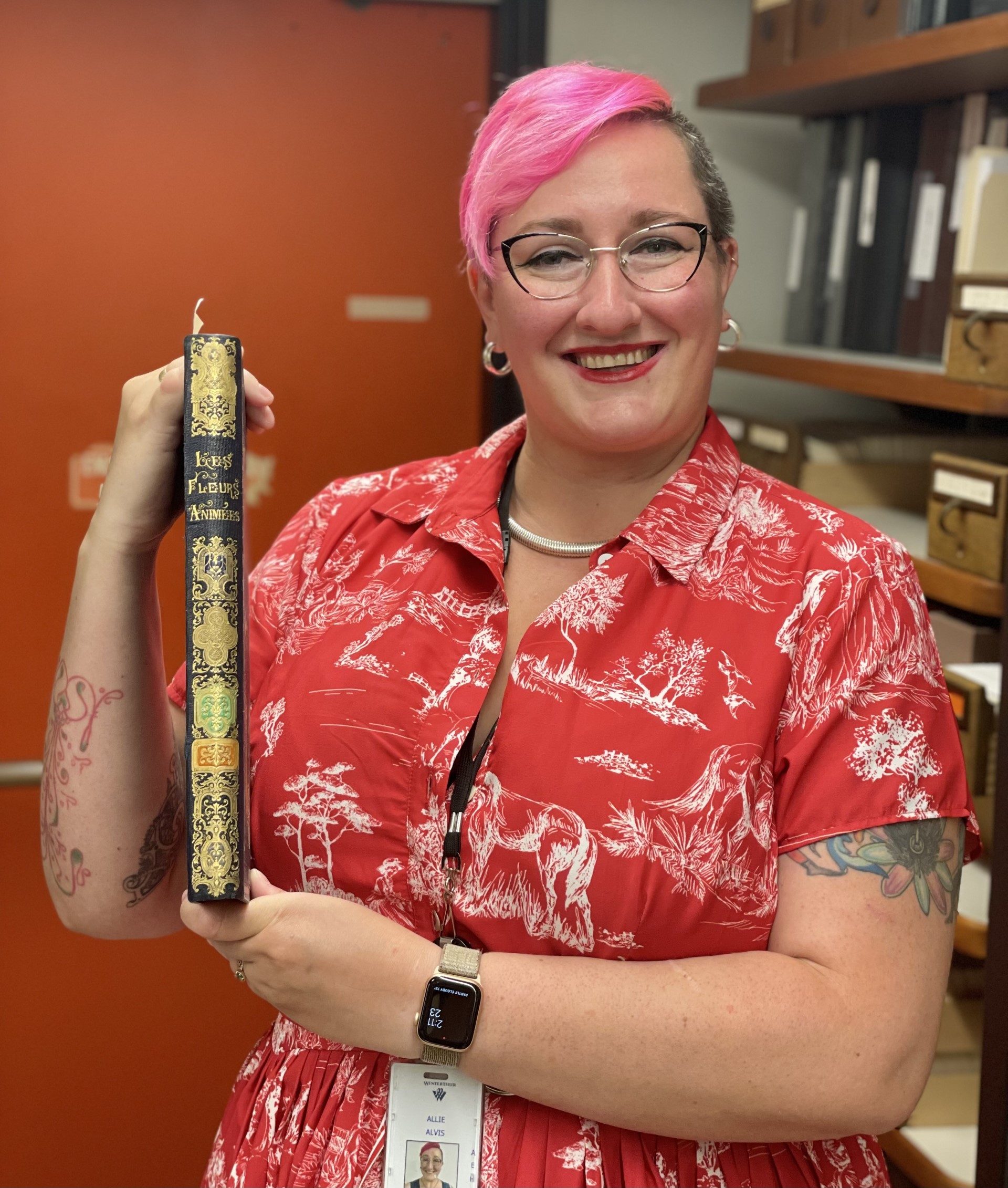
Allie Alvis is Curator of Special Collections of the Winterthur Library, where they are responsible for the stewardship and engagement of the collection. Allie has previously worked as an antiquarian bookseller at Type Punch Matrix (Washington, DC) and as the special collections reference librarian for the Smithsonian Libraries and Archives.
Allie's research is diverse and far-reaching, with interests in physical patterns of use in books, the history of ephemera, and Arts and Crafts book bindings. They have published on topics including the history of rebinding illuminated manuscripts, the reuse of type ornaments in 16th and 17th century England, the work of bookbinders Douglas Cockerell and Son, and the use of arsenical green pigments in bookbinding.
Allie is particularly involved in the study and act of using social media for communicating book history and maintains popular accounts across various platforms as Book Historia. They received MScs in Material Culture & Book History, and Information Management from the Universities of Edinburgh and Glasgow respectively, and a BA in Linguistics from the University of Kansas.
Visit us
Find our opening times, get directions, join a tour, or dine and shop with us.